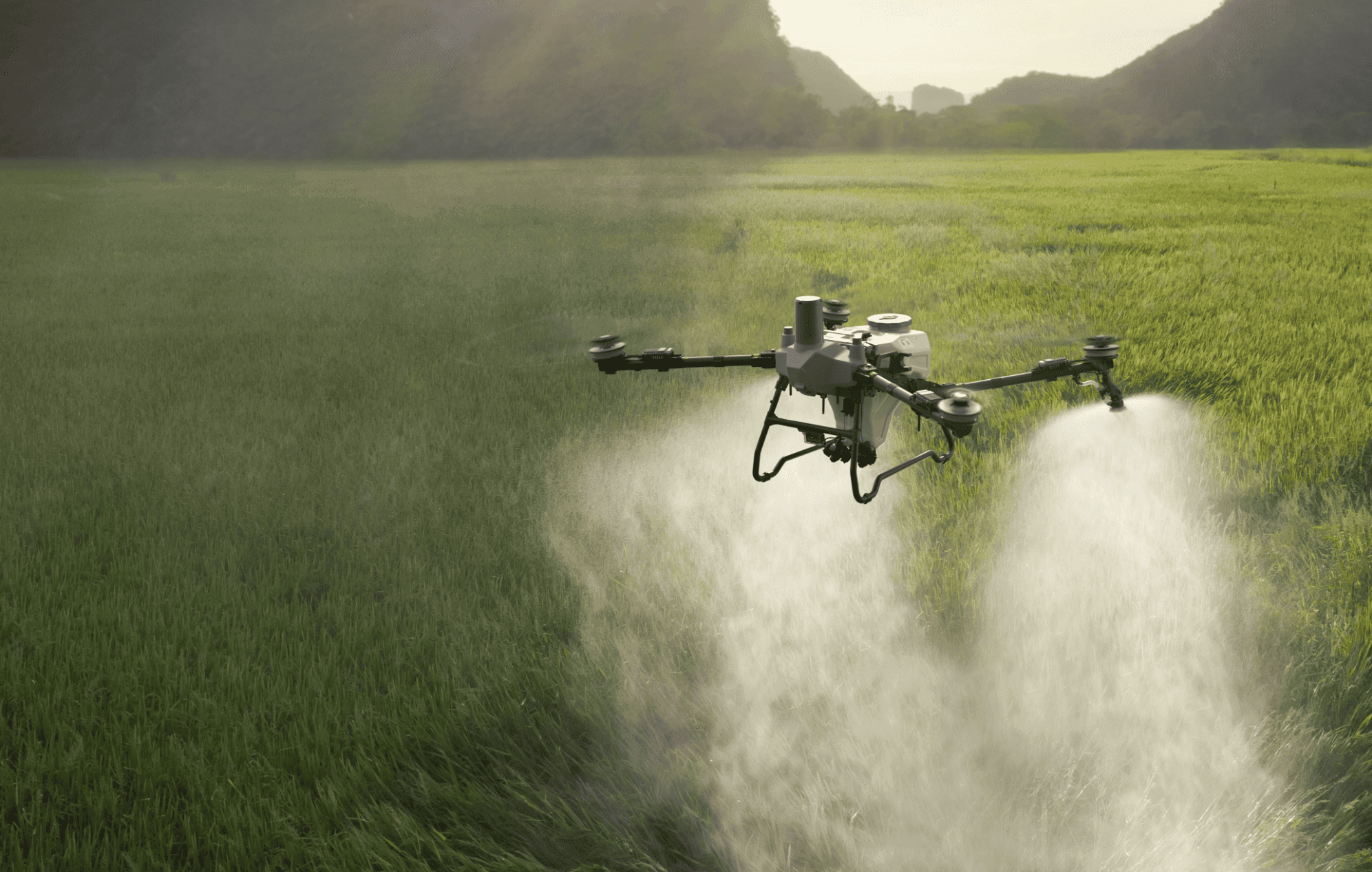
Choosing between the DJI Agras T100 and T50 comes down to more than tank size. For a Texas farm or ranch, the right drone depends on acreage, field layout, crop type, refill logistics, weather, labor, and how often you expect to spray.
The Agras T100 is the higher-capacity machine, built for large-scale operations and demanding application schedules. The Agras T50 is a smaller, more manageable platform that can still deliver professional spraying, spreading, mapping, and orchard capabilities.
Neither drone is automatically better for every operation. The better choice is the one that fits the way your farm actually works.
Quick answer: Choose the T100 when maximum payload and throughput are the priority. Choose the T50 when you need a capable agricultural drone with simpler transport, handling, and field logistics.
DJI Agras T100 vs. T50: Key specifications
The specifications below come from DJI’s official Agras T100 specifications and Agras T50 specifications pages. Actual performance depends on payload, weather, altitude, spray settings, field conditions, and equipment configuration.
| Feature | DJI Agras T50 | DJI Agras T100 |
|---|---|---|
| Spray tank volume | 40 L | 100 L |
| Standard maximum spray flow | 16 L/min | 30 L/min |
| Optional maximum spray flow | 24 L/min with four sprinklers | 40 L/min with four sprinklers |
| Effective spray width | 4–11 m | 5–13 m |
| Weight with battery or standard spray configuration | 52 kg with battery | 75 kg with standard two-nozzle spray setup |
| Maximum takeoff weight for spraying | 92 kg | 175 kg standard; 177 kg with optional four-nozzle setup |
| Spreading tank | 75 L | 150 L |
| Maximum spreading payload | 50 kg | 100 kg |
| Maximum wind resistance listed by DJI | 6 m/s | Less than 6 m/s |
The biggest difference is clear: the T100 carries substantially more liquid and dry material. That can reduce refill cycles and increase daily productivity, but it also requires more planning, heavier support equipment, and a stronger field logistics setup.
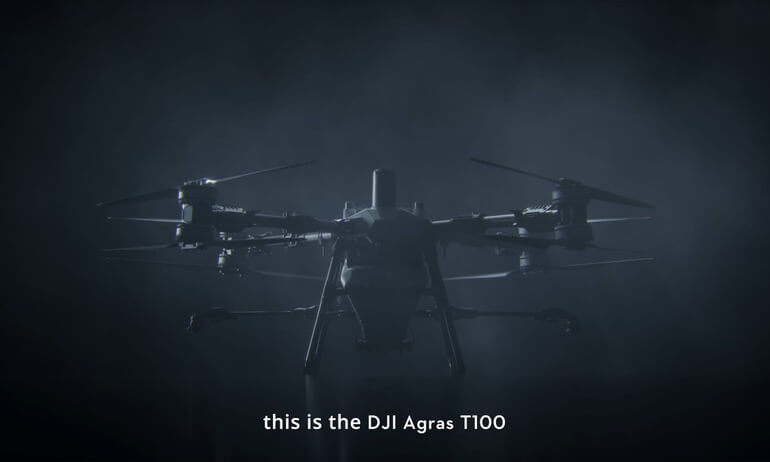
Official DJI Agras T100 imagery from DJI’s T100 product video page.
Where the T100 makes the most sense
The T100 is designed for operators who need to move a lot of product across large areas. Its 100-liter spraying tank is two and a half times larger than the T50’s 40-liter tank. Its higher flow rate also allows it to support wider or higher-volume applications when the job and product label require them.
That capacity can be valuable for:
- Large row-crop operations
- Broad pasture and rangeland applications
- Commercial custom application businesses
- Large properties with limited refill access
- Operations trying to reduce downtime between flights
- Farms that need spraying and spreading in the same equipment package
The T100 also supports a 150-liter spreading system and a 100-kilogram spreading payload in the standard configuration listed by DJI. That makes it a more flexible platform for fertilizer, seed, and other approved granular materials.
There is an important detail to understand, however. DJI’s newer T100 Dual Battery Spraying System uses a 90-liter tank configuration, while the standard T100 spraying specifications list a 100-liter tank. When comparing quotes, make sure you know whether you are evaluating the standard single-battery spraying system, the dual-battery system, or another regional configuration.
A larger drone can be more efficient, but only if your operation can keep it supplied. The T100’s capacity is most useful when you have a well-organized mixing and loading area, enough carrier product on hand, appropriate charging or generator capacity, and people who can keep the aircraft moving.
Where the T50 has the advantage
The T50 is not a small or entry-level consumer drone. DJI lists a 40-liter spray tank, up to 24 liters per minute with the optional four-sprinkler setup, and a 50-kilogram spreading payload.
That is enough capacity for many farms, ranches, orchards, specialty-crop operations, and custom jobs. The T50’s lower weight and smaller overall footprint can also make daily handling easier. Loading the aircraft, moving it between fields, staging it near a water source, and completing routine maintenance may be simpler than working with the larger T100 system.
The T50 may be the better fit when you:
- Treat smaller or irregularly shaped fields
- Work across multiple farms or scattered properties
- Need to maneuver around trees, fencing, ponds, or other obstacles
- Want lower equipment and support requirements
- Are adding drone spraying to an existing application program
- Need a platform that one or two trained operators can handle efficiently
DJI also designed the T50 for multiple agricultural applications. Its dual atomizing spray system supports adjustable droplet sizes, and its radar and binocular vision systems assist with obstacle sensing and terrain following. DJI states that the optional four-sprinkler configuration can increase flow for applications such as orchard spraying.

Official DJI Agras T50 imagery from the DJI Agras T50 product page.
What does this mean for Texas farms?
Texas operations vary widely. A rice producer near the Gulf Coast, a cotton grower in the High Plains, a pecan orchard in Central Texas, and a ranch in South Texas may all need very different equipment.
Large, open fields
For large contiguous fields, the T100’s larger tank and higher flow rate can reduce the number of refill stops. That may help when applications need to be completed during a narrow weather or crop-timing window.
The T100 is also a better candidate for a dedicated commercial application crew that already has trucks, trailers, water tanks, generators, batteries, mixing equipment, and ground support personnel.
Pasture and rangeland
Both drones can be useful in pasture and rangeland work, particularly where wet ground, rough terrain, or sensitive areas make ground equipment difficult to use. The T100’s payload advantage becomes more valuable as treated acreage increases.
For smaller ranch jobs, spot treatment, fence-line work, ponds, or scattered problem areas, the T50 may be easier to transport and stage. In those situations, the larger capacity of the T100 may not offset the extra equipment and handling requirements.
Orchards and specialty crops
Orchard spraying requires more than simply carrying a larger tank. Canopy density, tree height, row spacing, terrain, droplet size, air movement, and the product label all affect the result.
Both the T50 and T100 can be configured for specialized spraying tasks, but the T50’s smaller footprint may be easier to work with in tighter orchard blocks. The T100 may be the better choice for larger orchards where higher flow and longer operating cycles justify the additional logistics.
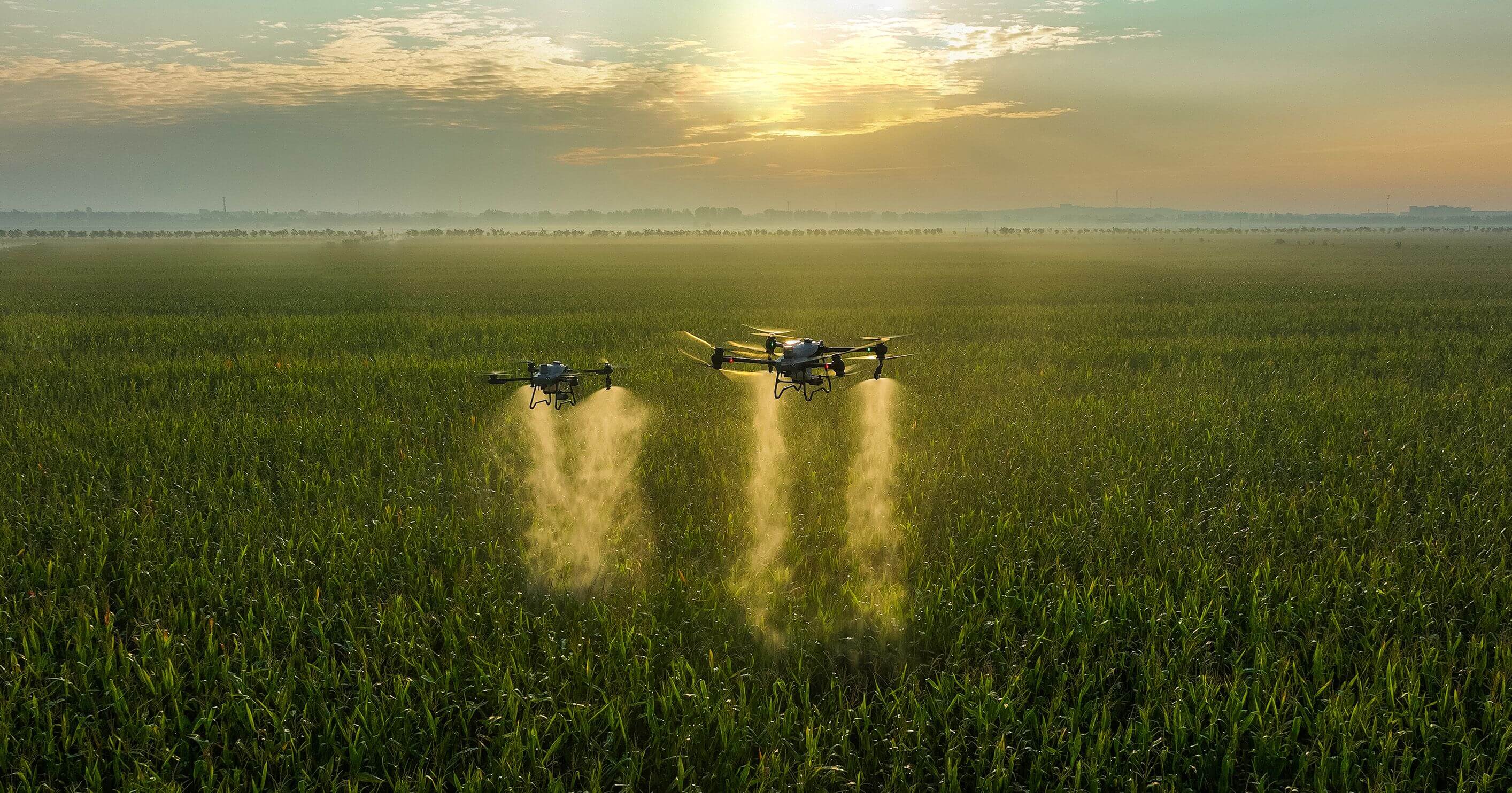
Official DJI agricultural drone imagery from the DJI Agras T50 and T25 launch announcement.
Weather and spray compliance still matter
A larger tank does not make it safe or legal to spray in poor conditions. DJI lists a maximum wind-resistance specification of 6 m/s for the T50 and less than 6 m/s for the T100. That is an aircraft capability rating, not permission to apply a pesticide in any particular wind condition.
Texas operators must follow the pesticide product label, including requirements for:
- Application rate and carrier volume
- Droplet size or spray quality
- Flight height
- Wind speed and direction
- Buffers and sensitive areas
- Personal protective equipment
- Environmental precautions
- Recordkeeping
The EPA pesticide label resource is a good starting point. For federal aircraft requirements, review the FAA’s guidance on dispensing chemicals with unmanned aircraft and the current 14 CFR Part 137 regulations.
In Texas, pesticide applicators should also review the Texas Department of Agriculture pesticide program. State licensing requirements may include the appropriate pesticide-use category and aerial application certification. Verify current requirements before beginning operations.
Batteries, charging, and field support
The T50 uses the DJI DB1560 Intelligent Flight Battery, while the T100 uses the larger DB2160 battery in the specifications published by DJI. Both systems depend on a reliable charging plan for productive field work.
That means your purchase decision should include more than the aircraft. Price out:
- Extra batteries
- Chargers or generators
- Water tanks and pumps
- Mixing and loading equipment
- Transportation
- Spare parts
- Maintenance
- Training
- Insurance
- Labor
- Compliance costs
The T100 can move more product per flight, but its batteries, generator, and ground-support equipment are also heavier and more demanding. A T50 system may provide a better return if your farm does not need the T100’s full capacity every week.
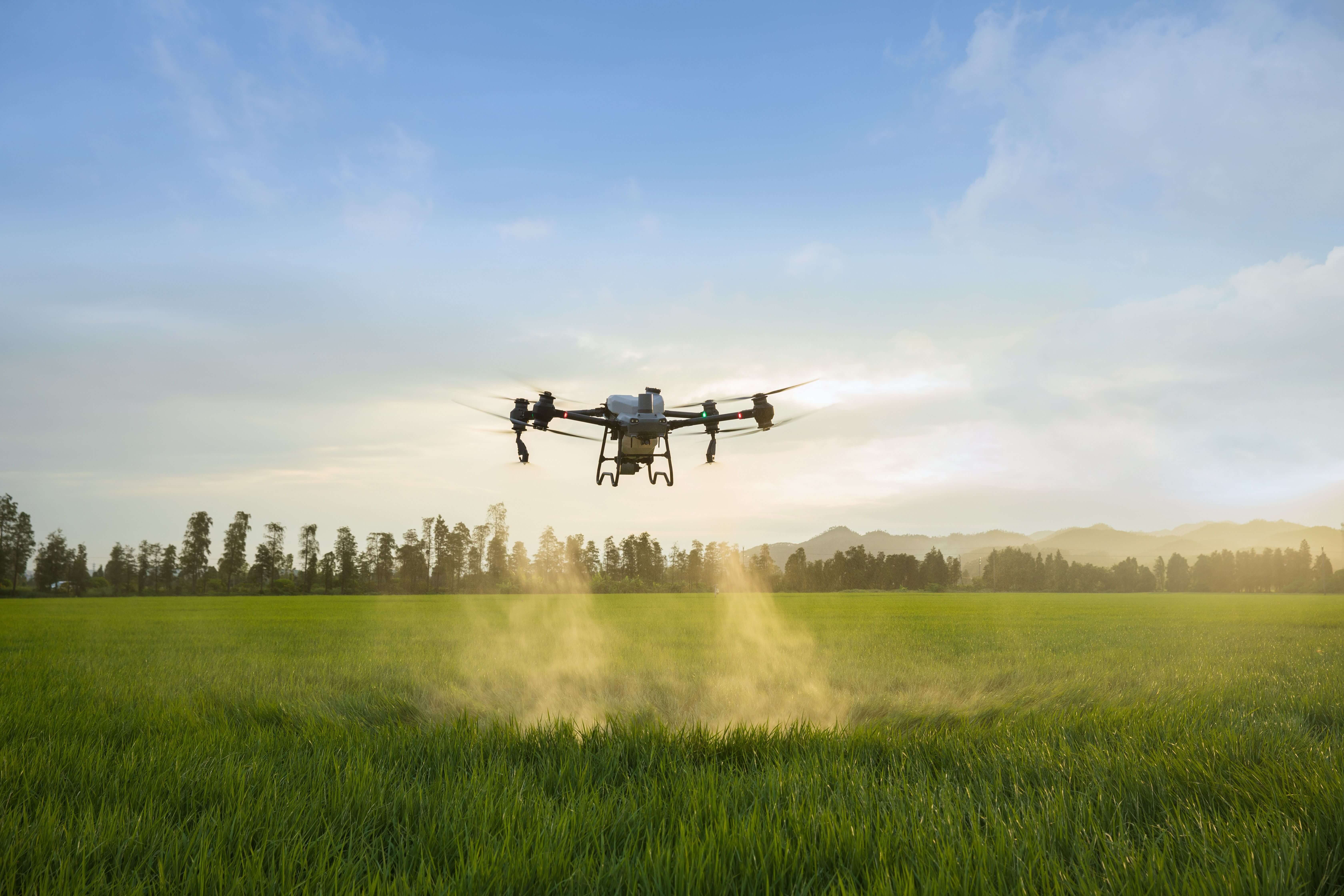
Official DJI Agras imagery from DJI’s T50 launch announcement.
T100 or T50: Which one should you choose?
Choose the DJI Agras T100 if your operation needs:
- Maximum spraying capacity
- Fewer refill cycles
- Higher potential throughput
- Large-field spraying or spreading
- A dedicated commercial application crew
- The infrastructure to support a heavier aircraft
Choose the DJI Agras T50 if your operation needs:
- A versatile agricultural drone for moderate acreage
- Easier transport and handling
- Lower logistical complexity
- Orchard, pasture, specialty-crop, or spot-treatment capability
- A practical platform for expanding into drone applications
The right decision should come from your acres per job, application volume, refill distance, crew size, and expected annual utilization: not just the largest number on the specification sheet.
Premier Outdoor Services helps Texas farmers, ranchers, and landowners evaluate agricultural drone equipment, custom spraying, mapping, repairs, and field support. You can explore our DJI Agriculture sales page or learn more about our drone services for Texas agriculture.
Before purchasing, compare the complete system and confirm current product availability, configuration, pricing, and regulatory requirements with an authorized dealer and the responsible agencies.